
In short

From Sunlight to Your Appliances

Plug-in solar produces electricity on your balcony, patio or yard, the same kind your utility delivers, and feeds it into your home’s wiring through a standard outlet. Load Guard measures your home and makes sure that power is used safely. Here is what each part does, why Load Guard is required, and how your home uses solar first to lower your power bill.

Drag the circle or tap a part← Swipe →

Hover to explore

Solar panels

Turn sunlight into direct current (DC) electricity.

Each panel is made of solar cells. When light hits a cell, it frees electrons in the silicon and creates a direct current. How much power a panel makes depends on how strong the sunlight is, the angle of the panel, shading and temperature.

  • 01The watt rating is measured under standard test conditions. Real output is usually lower and changes through the day.
  • 02Premium and Pro panels are bifacial: they also capture light reflected onto their back side, for more output.
  • 03Panels never connect to your home directly. Their DC power always goes through an inverter first.

Also in every system

Mounting and the App

Glass solar panels on CraftStrom ground-mount stands
Ground-mount stand800 W to 4,000 W kits
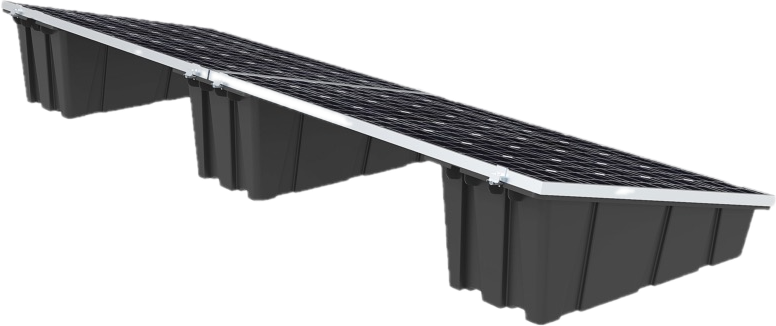
Solar panels on CraftStrom tub mounts
Tub mountOption for 4,000 W kits

Mounting

Holds your panels at the right angle, safely.

The angle and direction of your panels matter as much as their size. Kits from 800 W to 2,000 W come with aluminum ground-mount stands. 4,000 W kits come with a choice of the same stands or tub mounts.

  • 01South-facing panels make the most power over the day.
  • 02East and west orientations spread production into the morning and evening.
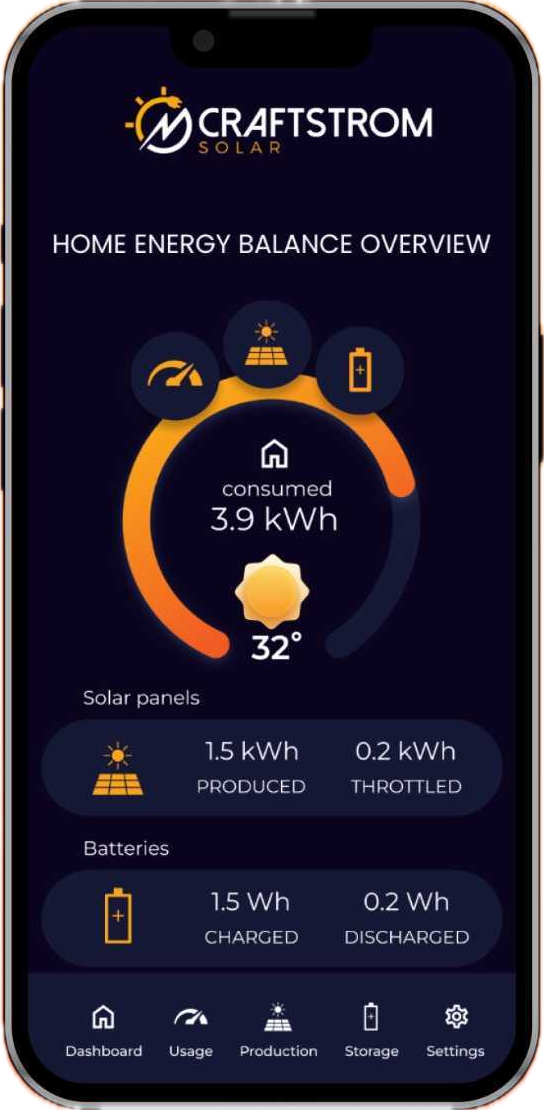
CraftStrom app dashboard on a phone

CraftStrom app

Shows what your system is doing.

The free CraftStrom app shows your solar production, your home's electricity use as measured by Load Guard, and the status of every device. It is also where you set up and update your system.

  • 01Live and historic production.
  • 02Home use measured by Load Guard.
  • 03System status and Load Guard activity.

See it in action

Plug-in solar from CraftStrom, explained.

A short, high-level look at how a CraftStrom plug-in solar kit comes together: panels on their stands, smart inverters, Load Guard and the app, all connected to your home through a standard outlet.

  • 01What comes with every kit.
  • 02How the system plugs into your home.
  • 03How Load Guard and the app keep it in check.

Only at CraftStrom

Meet Load Guard

CraftStrom Load Guard is the smart control device included with your CraftStrom system. It measures how much electricity your home is using and helps the system adjust solar output to match. That gives you more control than a basic panel-and-inverter bundle that produces at a fixed level whenever the sun is out.

Measures every 0.1 seconds
Direct device-to-device communication
Zero export: nothing back to the grid
Up to four circuits

Why it matters

The Component the Rules Require

Plug-in solar is safe when two things are guaranteed: the system must never overload the circuit it is plugged into, and it must not push power onto the grid without the utility's agreement. U.S. plug-in solar laws, the UL 3700 safety outline and the National Electrical Code all come back to these two requirements. In a CraftStrom system, Load Guard is the component that meets them.

State laws

Plug-in solar laws

New state laws set a size limit for systems that send power to the grid, for example 1,200 W, and require that a system does not overload the circuit it uses. Larger systems are allowed when they don't export: that is zero-export control.

State legislation →

UL 3700

UL safety outline

UL 3700 evaluates the complete plug-in system. It includes requirements for power control, so a system that manages its own output keeps the branch circuit within its rating, together with protection against unintended export.

UL 3700 explained →

NEC

National Electrical Code

The NEC limits how much power may be fed into a circuit and an electrical panel (Article 705.12) and allows power control systems to enforce that limit automatically (Article 705.13). Load Guard's circuit-aware control works on exactly this principle.

Load Guard job 1

Circuit-Aware Protection: Keeping Your Wires Safe

The wires in your walls can only carry so much electricity before they get too hot. Here is how Load Guard helps keep them safe.

1

Your breaker can miss the solar power

Power companyBreaker boxAppliances use 22 A+10 A solarCircuit 1Breaker only sees 12 A

Your breaker only counts the electricity coming from the power company. Plug-in solar adds its own electricity in the middle of the wire, behind the breaker's back, so the wire can end up carrying more than the breaker thinks. This is called breaker masking. We then throttle output to protect your wires.

Load Guard job 2

Zero-Export Control

Your home uses solar power first. When your panels make less than your home is using, the grid supplies the difference. When your panels make more than your home needs, Load Guard turns solar output down. If you add a compatible battery, the system can store that energy for later instead. This is called zero-export control: the system is configured so excess solar power is not sent back through the utility meter.

Single-phase zero export

Power companyPhase 1Phase 2Breaker boxCircuit 1Circuit 2Circuit 3Appliances use 600 WAppliances use 400 WPhase 1 needs 600 WPhase 2: monitoredbut not covered by solarProducing 600 W

One CraftStrom solar system is connected on one electrical phase. Load Guard measures electricity use on that phase and adjusts the solar system's output to match it.

Two-phase zero export

Power companyPhase 1Phase 2Breaker boxCircuit 1Circuit 3Circuit 2Circuit 4Appliances use 2,000 WAppliances use 1,800 WDelivers 800 WDelivers 700 WProducing 1,200 WProducing 1,100 WEach phase on its own

CraftStrom solar systems are connected on both phases of a typical U.S. home. Load Guard controls each phase separately. Each solar system responds to electricity use on the phase where it is connected.

Up to Four Separate Circuits

Load Guard can support protection logic for up to four separate plug-in system circuits. Each circuit is measured separately, which helps the system manage the output of the products connected to it, for example:

  • Four separate CraftStrom plug-in solar systems
  • Plug-in solar systems on different household circuits
  • Other compatible plug-in energy products in a configured system

What Happens to Extra Solar Power?

Your home uses solar power first. Solar power that is not used is lost. If your panels are making more than you are using, the system turns solar output down. With compatible battery storage, that energy is stored for later use instead, based on your system settings and equipment.

This keeps the system focused on the energy your household can actually use, instead of treating solar as a fixed output. It is also why knowing your own usage matters so much for your savings.

Solar first

Your Home Uses Solar First

Electricity always flows to where it is being used, along the shortest path. When your solar system feeds power into an outlet, your appliances use that power first. Your utility meter only counts the electricity your home still needs on top of it. With a battery, the order looks like this:

Solar from your panels

Whenever the sun is shining, your home runs on your own solar power first. Every kilowatt-hour from your panels is one you don't buy.

Your battery

With Load Shifter, the solar your home couldn't use at midday powers your home in the evening.

The utility grid

Only what solar and battery can't cover is bought from your utility, as before. You never lose your grid connection.

A typical day

12:00 am

Night: your home runs on the grid, as before.

12 am6 am12 pm6 pm12 amSolar usedat homeExtra solarcharges the batteryBatteryFrom the gridGridYour home’s use

Over the whole day, this home gets 57% of its electricity from its own solar: 4.0 kWh straight from the panels and 4.0 kWh from the battery in the evening. The other 6.0 kWh, mostly at night, comes from the grid as before.

Illustration of a typical home with a plug-in solar system and a battery. Your curves depend on your home, your system and the weather.

How This Saves You Money

Plug-in solar saves money by replacing electricity you would otherwise buy. Each kilowatt-hour your home uses from your panels is a kilowatt-hour your utility doesn't bill you for, at your full retail rate, including the delivery charges that make up a large part of most bills. Because a CraftStrom system runs zero-export, solar power that your home doesn't use is not credited to you. That makes one number decisive: how much of your solar power your home actually uses.

Example
Solar energy your home uses in a year1,800 kWh
Your electricity rate$0.30 per kWh
Electricity you no longer buy$540 per year

Illustrative example. Your production depends on location, orientation and shading; your rate depends on your utility. Estimate your own savings with our calculator →

Know your usage

See Every Watt. Use Every Ray.

Most people only see their electricity use once a month, as one number on a bill. Load Guard measures your home's use continuously, and the CraftStrom app shows it to you. That information is crucial to your savings: solar only saves money when it is used, and you can only line up your production with your usage when you know when and how your home uses electricity.

1

Know your base load

Your base load is what your home always uses: refrigerator, freezer, router, fans, devices on standby. Solar that covers your base load is used almost completely, so it is the most valuable part of your system.

2

Size your system right

A system that is much larger than your daytime use spends sunny hours turned down. Knowing your usage curve helps you choose a kit, and later an expansion, where nearly every kilowatt-hour is used, so you don't pay for panels you can't use.

3

Shift flexible loads to the sun

Dishwasher, laundry, dryer, pool pump, EV charging: many loads can run at midday instead of the evening. Moving them into sunny hours turns surplus solar into savings.

4

Decide on a battery with facts

Your data shows how much surplus your panels make at midday and how much you use in the evening. That tells you whether a battery pays off for you, and how big it should be.

5

Beat time-of-use rates

Many utilities charge more in the late afternoon and evening. Knowing when you use power lets you shift usage and battery energy into those expensive hours.

6

Find waste

A high base load at night often means devices that run without being needed: old freezers, heaters, standby electronics. Seeing it is the first step to switching it off.

Example: using midday surplus

A home uses about 350 W during the day while nobody is home, and a 1,200 W system produces up to about 1,000 W at noon. Without changes, a large part of the midday solar is turned down. Running the dishwasher (about 1.2 kWh) and one laundry load (about 1 kWh) at midday instead of the evening uses that surplus.

Energy shifted into sunny hoursabout 2.2 kWh per day
At $0.30 per kWhabout $0.66 per day
Extra savings, same systemabout $240 per year

Illustrative example. Actual savings depend on your appliances, your rate, the season and the weather.

Ready to Make Your Own Power?

Find the right system for your space, or talk to our U.S.-based team.

FAQ

Frequently Asked Questions

Will it work with my outlet and circuit?

Most homes use a standard outdoor or indoor outlet on a circuit without heavy loads. Load Guard watches your home's use and turns output down to stay within the safe circuit limit. Run our 5-point outlet check before you buy.

Will it save enough to be worth it?

Tell us your bill and we'll show three numbers: conservative, typical and best-case. Savings come from using the power at home during the day.

Where can I put it?

Anywhere with 4+ hours of direct sun near an outlet: balcony, fence, deck, porch, shed or yard. The kit finder asks about your spot and cable run.

Will it run my house in an outage?

Solar alone lowers your bill but doesn't power your home when the grid is down. Add a battery kit to keep essentials like the fridge, lights and Wi-Fi running.

Is it allowed where I live?

Yes. CraftStrom works in all 50 states. Load Guard keeps every watt in your home, so nothing flows back to the grid.

What happens to extra power?

Your home uses solar first. If you're making more than you use, Load Guard turns the panels down, or a battery stores it for later.

What will I pay and when will it arrive?

See your full price, shipping and delivery window before checkout. No surprise accessories.

Can I take it with me?

Yes. It unplugs and moves with you, and it works in all 50 states.

Can I trust the equipment?

UL-certified inverters, NEC compliant, tested by Lawrence Berkeley National Lab and NREL, with warranties of up to 20 years.

What if I get stuck?

Our Houston team can walk you through Load Guard setup or Wi-Fi by appointment, and our FAQ covers the rest. Call (832) 850-3832.

More questions? Call (832) 850-3832 or email us.

Solar Calculator